


By Li Mo, People’s Daily
A glacial collapse in Nepal on Aug. 26 triggered a devastating mudslide, causing massive casualties, leaving many unaccounted and resulting in substantial property damage. According to data released by Nepal’s National Disaster Risk Reduction and Management Authority, as of 9 a.m. local time on Aug. 30, the mudslide had left 734 people dead and 2,498 missing.
In swift response, China mobilized emergency assistance for Nepal. At around 7 a.m. local time on Aug. 30, two Y-20 large transport aircraft landed at Tribhuvan International Airport in Kathmandu, carrying 13,200 pieces, or 50 tons, of relief supplies, including tents, blankets, compressed food, sleeping bags and first-aid kits.
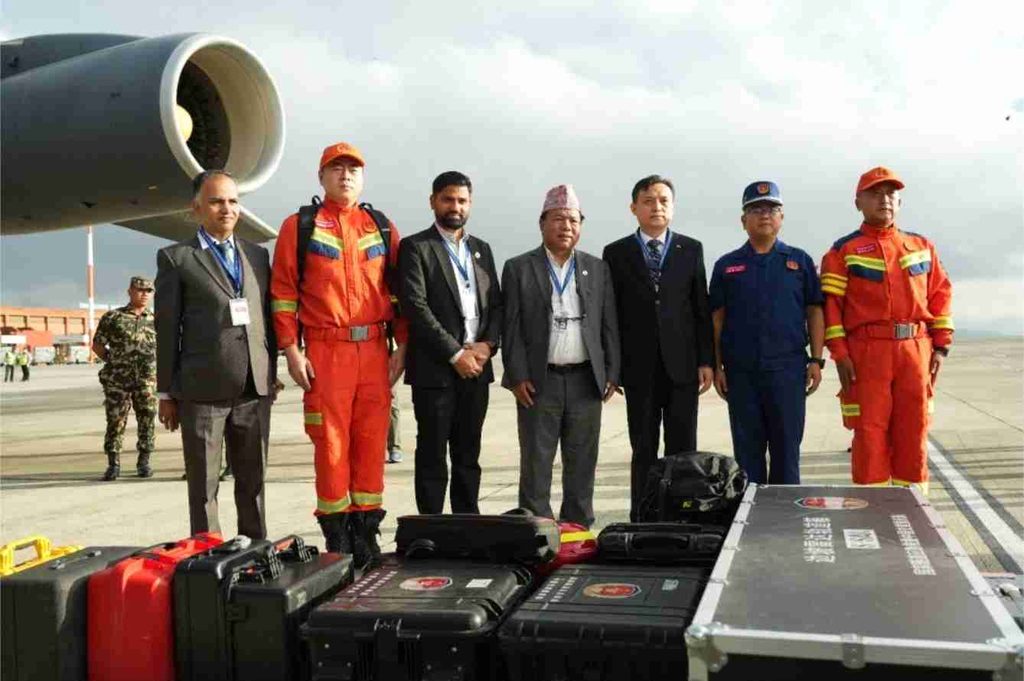
Chinese tunnel rescue experts arrive at Tribhuvan International Airport in Kathmandu, Nepal. (People’s Daily/Li Mo)
Chinese Ambassador to Nepal Zhang Maoming and Mahabir Pun, Nepal’s Minister of Science, Technology and Innovation, attended the handover ceremony at the airport. Pun expressed his heartfelt gratitude to the Chinese government and people for their valuable support, saying the supplies would play an important role in relief efforts in the disaster-hit area.
Immediately after the disaster struck, the Chinese Embassy in Nepal activated its emergency response mechanism and worked tirelessly to address the situation. Embassy officials at all levels maintained round-the-clock communication with relevant Nepalese authorities.

Chinese Ambassador to Nepal Zhang Maoming (first from left) hands over disaster relief supplies to Mahabir Pun, Nepal’s Minister of Science, Technology and Innovation (second from left) at Tribhuvan International Airport in Kathmandu, Nepal. (People’s Daily/Li Mo)
On Aug. 26, the China Meteorological Administration and the Department of Hydrology and Meteorology of Nepal held an emergency online meeting to assess the disaster and share data. China’s Ministry of Water Resources closely monitored the situation of the barrier lake, carried out calculations and analyses on potential flood outflows, and continued sharing hydrological and meteorological information as well as monitoring data on the barrier lake with the Nepalese side.
At the request of the Nepalese government, China’s Ministry of Emergency Management dispatched five Chinese tunnel rescue experts on Aug. 29. They flew by helicopter from Gyirong in southwest China’s Xizang autonomous region to the disaster zone in Nepal and immediately joined rescue operations at a hydropower station tunnel. The experts have now arrived in Rasuwa, the worst-hit zone, where they are searching for people trapped in the tunnel.
On Aug. 30, Zhang met with Nepal’s Minister of Finance Swarnim Wagle and handed over $2 million in emergency flood relief assistance provided by the Chinese government, along with $200,000 from the Red Cross Society of China to the Prime Minister Disaster Relief Fund of Nepal.
Zhang said that responding to the mudslide disaster is an urgent priority for both China and Nepal. Chinese leaders have extended thier deepest condolences and heartfelt sympathies to the Nepalese people. China stands ready to work hand in hand with Nepal to stand together through this difficult time and overcome the challenges together.
In addition to financial aid, Chinese tunnel rescue experts are continuing to support rescue efforts, while the first batch of relief supplies has already arrived. China will continue providing support, including disaster-area imagery, hydrological and meteorological information. With the joint efforts of both sides, the people of the two countries will surely overcome the disaster at an early date, Zhang said.
Minister Wagle expressed the Nepalese government’s heartfelt gratitude for China’s generous assistance, praising the profound friendship demonstrated by both nations during this difficult time. He confirmed that Nepal would make full use of the Chinese aid and do everything possible to carry out rescue and relief operations. He also expressed hope for close bilateral cooperation in post-disaster planning and reconstruction.
Also on Aug. 30, the Information Office of the People’s Government of Xizang Autonomous Region held a press conference to brief the public on rescue and relief efforts following the mudslide disaster in Gyirong county. Following the disaster, the region promptly activated the highest-level emergency response for natural disasters and the highest-level emergency relief response, coordinating resources from all sides to carry out search and rescue efforts.
Su Pengcheng, a researcher at the Institute of Mountain Hazards and Environment under the Chinese Academy of Sciences, said the disaster originated on the northern slope of Mount Langtang Lirung in Nepal, where a glacial rupture triggered an ice-rock avalanche at an altitude of about 5,200 meters.
The falling mass scoured the mountainside and generated a mudslide, which traveled rapidly along the river for about 22 kilometers before reaching the Chinese Gyirong Port at an altitude of about 1,800 meters.
The disaster flattened about 0.7 square kilometers of land, including 27 buildings and associated facilities. The ice-rock avalanche took only about six to seven minutes to reach Gyirong Port after it occurred.
The affected area is characterized by high mountains, deep valleys and fast-flowing rivers. Complex and highly variable air currents, surrounding glaciers and glacial lakes, and the serious safety risks posed by the formation of barrier lakes have made rescue operations particularly challenging.
National Highway 216 was severely damaged, while power and communications were disrupted. Rescue efforts are currently being carried out mainly through three methods: lowering firefighters by rope from helicopters, reopening roads for rescue operations, and transporting rescue personnel by helicopter.
A comprehensive assessment shows that the most prominent risk constraining disaster response — the barrier lake formed upstream of the core disaster-hit area — has begun overflowing and releasing water. The situation is currently stable overall, and the likelihood of a complete breach is relatively low. Rescue personnel are making the most of this favorable window to reopen access routes as quickly as possible and step up search and rescue operations.




