By Shang Rongzheng, People’s Daily
Under the blazing midday sun, temperatures in Turpan, northwest China’s Xinjiang Uygur autonomous region, had already soared above 40 degrees Celsius. Yet amid the sprawling vineyards of Shalek village in Ya’er township, Gaochang district, the gentle sound of flowing water could still be heard.
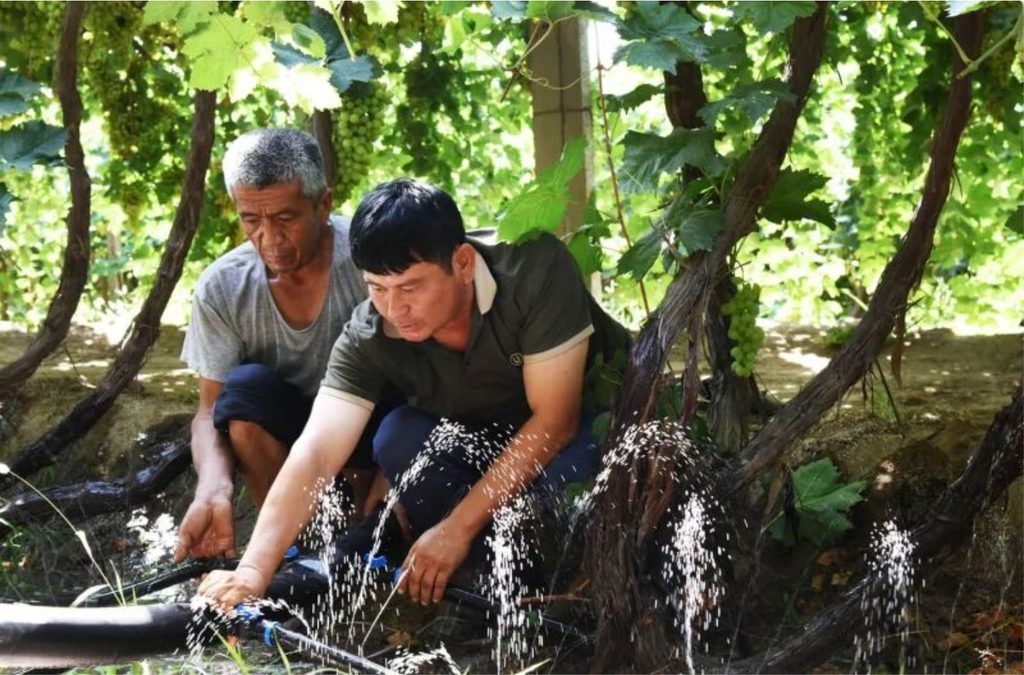
High-efficiency water-saving irrigation is used in Shalek village in Ya’er township, Gaochang district, Turpan, northwest China’s Xinjiang Uygur autonomous region. (Photo/Liu Jian)
“Come on, let me show you my vineyard!” said Rahman Wupur, a local villager, as he led the way. Along the irrigation channels, small streams of water continuously sprayed from tiny holes in pipes. Clusters of grapes hanging from the vines glistened in the sunlight.
The irrigation channels were more than 40 centimeters deep, but the water pooling in them measured no more than 10 centimeters, leaving much of the channel seemingly dry.
“If we use flood irrigation, the grapevines can effectively use only about half of the water. Most of the rest simply evaporates, resulting in significant waste,” said Wang Xiaoyan, a deputy official with the Turpan water resources bureau.
According to Wang, water is also lost to evaporation as it travels several kilometers through open channels to reach the vineyards, with nearly 30 percent lost along the way.
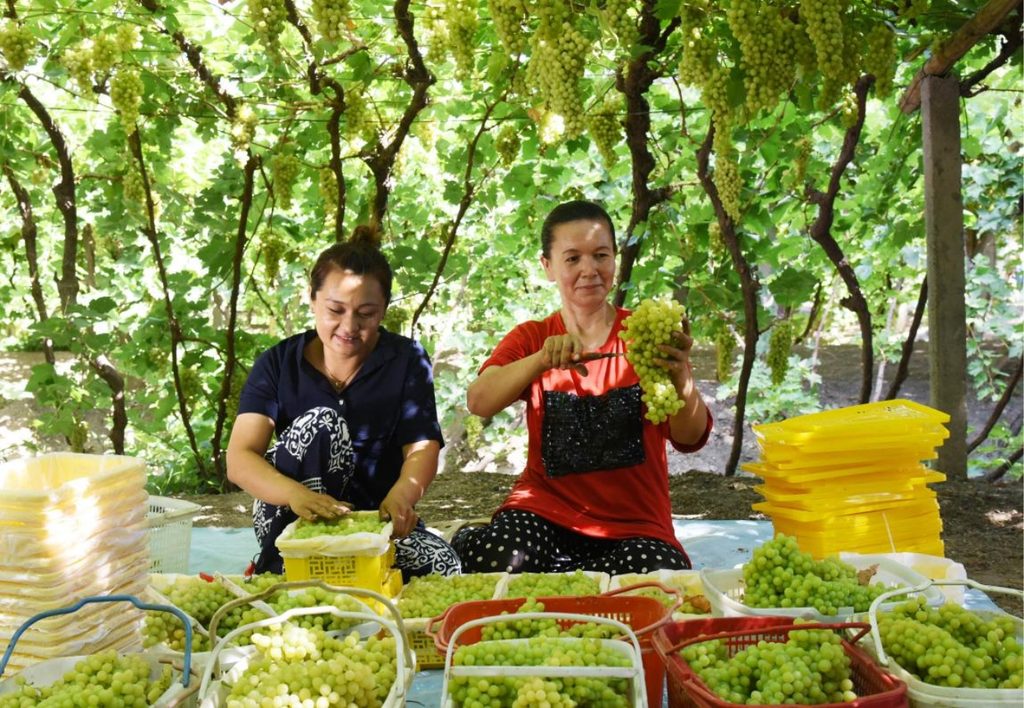
Farmers pack grapes at a vineyard in Gaochang district, Turpan, northwest China’s Xinjiang Uygur autonomous region. (Photo/Liu Jian)
Known as the “Flaming Land,” Turpan experiences some of China’s most extreme summer heat, with temperatures exceeding 50 degrees Celsius and ground surface temperatures topping 70 degrees Celsius. The region receives an average annual precipitation of just 14.7 millimeters, while its average annual evaporation reaches 2,477.5 millimeters. Water resources are inherently scarce. Agriculture accounts for more than 80 percent of the region’s water use, with a large share devoted to grape cultivation.
Since 2023, Turpan has been rolling out a high-efficiency, water-saving irrigation project in its vineyards. The initiative is phasing out water-intensive flood irrigation and replacing it with micro-sprinkler systems that deliver water according to the actual water demand.
The first change was how the water was transported. Following the micro-sprinkler irrigation pipes from Rahman Wupur’s vineyard to the edge of the field, one can see that the pipes emerge from underground. Their source is a water storage basin several kilometers away.
Aret Rahmutul, an official with the Gaochang district water resources bureau, told People’s Daily that water from the basin is pumped to a higher pressure before being delivered through underground pipelines to individual vineyards.
This system eliminates the evaporation losses caused by transporting water over long distances on the surface, much like the underground channels used by the traditional karez irrigation system, a water supply system for the purpose of transporting usable water to the surface from an aquifer or a well through an underground aqueduct, Aret Rahmutul added.
Since the project began, Turpan has laid a total of 16,200 kilometers of pipelines and 146,900 kilometers of micro-sprinkler tape, covering about 550,000 mu (36,667 hectares) of vineyards.
The second change was in how the water is applied. Micro-sprinkler irrigation follows a “slow and steady” approach. Each irrigation session lasts two to three hours, allowing water to be sprayed gently and gradually seep into the soil. Although only a small amount of water accumulates in the channels, it is enough to fully meet the grapevines’ needs.
“After each irrigation session, the water left in the soil continues to seep downward and is fully absorbed by the grape roots, greatly reducing waste,” Aret Rahmutul said.
Monitoring has shown that since the high-efficiency water-saving irrigation project was introduced, each mu of vineyard has saved more than 200 cubic meters of water a year while maintaining an adequate water supply for the grapevines. Water and electricity costs have also fallen by more than 50 yuan per mu.
The transition from “more than enough” to “slow and steady” watering requires grape roots to gradually adapt. To this end, local authorities have adopted a gradual water-reduction strategy, reducing the amount of water supplied to the grapevines year by year.
When Rahman Wupur first learned that flood irrigation would be replaced by micro-sprinklers, he was firmly opposed.
“This is how our families have grown grapes for generations. The water from micro-sprinklers is so little. What if the vines don’t get enough water and the harvest suffers?” he said. A potential drop in output was the greatest concern for him and other local growers.
But seeing is believing. The village organized growers to visit a demonstration vineyard where the high-efficiency water-saving irrigation project had been implemented. As they gathered beside the irrigation channels, staff members used shovels to dig into the soil around the grape roots, checking how far the micro-sprinkler water had seeped and whether the roots were receiving adequate moisture.
“We dug down one meter, and the soil was still moist,” Rahman Wupur said, adding that this demonstration greatly reassured him. During the harvest, staff measured the output of the demonstration vineyard and found that micro-sprinkler irrigation had not reduced yields. Rahman Wupur could finally put his mind at ease.
Today, the high-efficiency water-saving irrigation project covers more than 80 percent of Turpan’s vineyards. In this “Flaming Land,” every drop of water is being put to more efficient use.