By Wang Haonan, People’s Daily
The 2026 Beijing E-Town half-marathon on April 19 captured widespread attention, as China’s humanoid robots showcased rapid advances in speed, endurance, and autonomy.
“Lightning,” a humanoid robot developed by the Qitian Dasheng Team, claimed victory with a winning time of 50 minutes and 26 seconds, outpacing the current man’s half marathon world record. Participation surged from 20 teams in 2025 to over 100 this year, reflecting accelerating technological advancement.
Just over 20 teams took part last year, compared with more than 100 this year, reflecting both growing interest and fast-paced technological progress.
“Nearly 40 percent of teams achieved autonomous navigation this year,” said Liang Liang, deputy secretary-general of the Chinese Institute of Electronics. “We’re witnessing breakthroughs across models, algorithms, design, and hardware integration. The goal is to accelerate both technological and industrial development.”
Performance gains have been striking in just one year. Completion times have dropped from over two hours in 2025 to under one hour this year. Teams attributed the leap forward to major improvements in material durability, system reliability, and joint heat resistance — key factors enabling sustained long-distance operation.
The robot Tiangong Ultra, winner of last year’s inaugural race, ran with steady strides and coordinated arm movement without human guidance.
“In simulations, tens of thousands of virtual robots logged a combined 27,300 hours of running and went through over 100,000 iterations,” said Xu Zhiyuan, head of motion control at the Beijing Innovation Center of Humanoid Robotics. “At near-professional human speeds, perception and decision-making windows shrink dramatically, requiring major power upgrade, algorithms, and system responsiveness all had to be upgraded.”
For many teams, the race has become a testing ground for innovation.The Taishan Team from east China’s Shandong province experienced this firsthand. At last year’s World Humanoid Robot Games, their robot “Xingzhe Taishan,” standing 1.38 meters tall, drew attention for continuing to run even after losing an arm.
“Since March, we’ve trained our robot at marathon intensity, running a half marathon every day,” said Liu Dayu, head of new technologies at Yobotics, the developer of the robot. To address overheating and mechanical fatigue, we developed a liquid cooling system and reinforced key materials.
Robots competing this year were visibly far more capable than before. Ultra-fast robot battery swapping emerged as a major highlight of the event. Finished in less than 10 seconds, the precise operation was as fast as Formula One pit stops.
“In the past, battery changes took several minutes and requiring a system reboot,” said Xing Boyang, technical director at Humanoid Robot (Shanghai) Co., Ltd. “Now, it takes just seconds, with no interruption.”

Humanoid robot Tiangong 3.0 competes in the 2026 Beijing E-Town humanoid robot half-marathon. (Photo/Shi Gangze)
Advances in thermal management have also played a crucial role. By combining liquid and air cooling, teams have reduced joint temperatures from 70-80 degrees Celsius to around 60. Meanwhile, upgraded battery technologies have enabled longer continuous operation, significantly improving race performance.
“The competition is driving innovation in batteries and beyond — these are breakthroughs you simply can’t achieve in the lab alone,” Xing noted.
More than a competition, the event serves as an extreme real-world testbed for the humanoid robotics industry. Data collected from the race is expected to accelerate breakthroughs in embodied intelligence, motion control, and related fields.
This year’s competition saw a fivefold increase in the number of participating teams, including five international teams making their debut, adding greater diversity to the field.
Interestingly, many teams used the same robot “base model,” yet their performance varied widely depending on software and system optimization. These “secondary developers” ranged from companies and research institutions to university teams and independent enthusiasts.
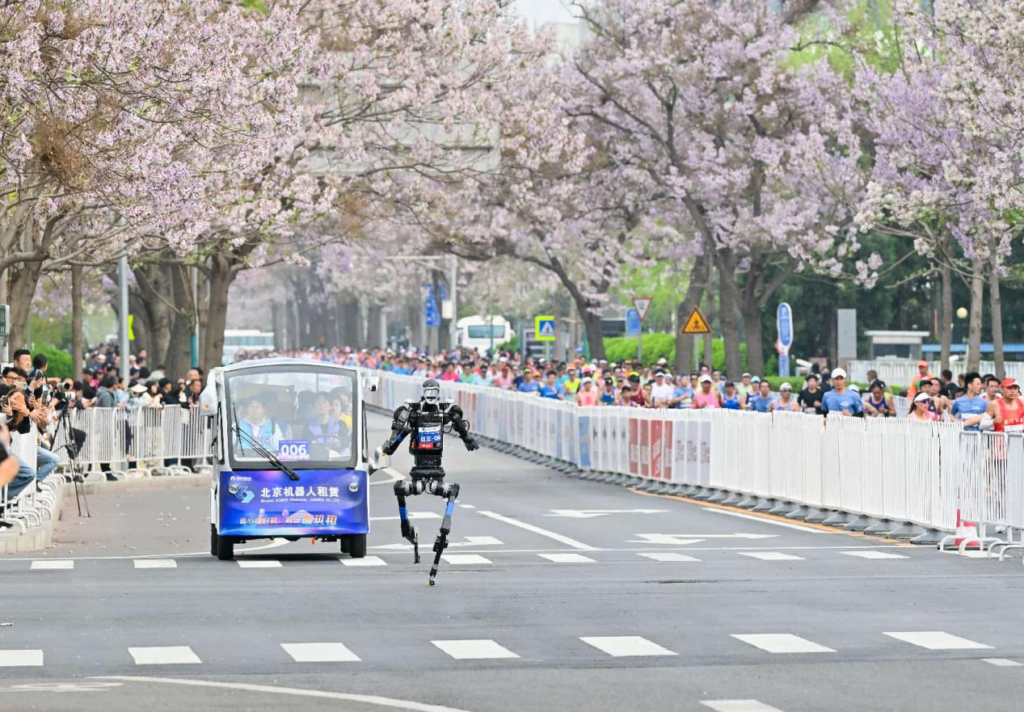
Humanoid robot H1 developed by Unitree competes in the 2026 Beijing E-Town humanoid robot half-marathon. (Photo/Shi Gangze)
“The base model is like a blank shell — we bring it to life through our own ideas,” said Dou Yuhan, a doctoral student from Huazhong University of Science and Technology, whose team developed its own algorithms on the Tiangong 3.0 platform. He believes broader participation is key to advancing humanoid robotics.
Notably, all five international teams chose Chinese-made base models, highlighting a growing trend of “Chinese hardware, global intelligence.”
Only one robot claims the title, but every team that has made it to the starting line is a winner. As the event’s slogan puts it: “Who takes part is a hero; who finishes wins glory.” As sport and technology converge, it is not only the machines that are accelerating, but the pace of innovation itself.